

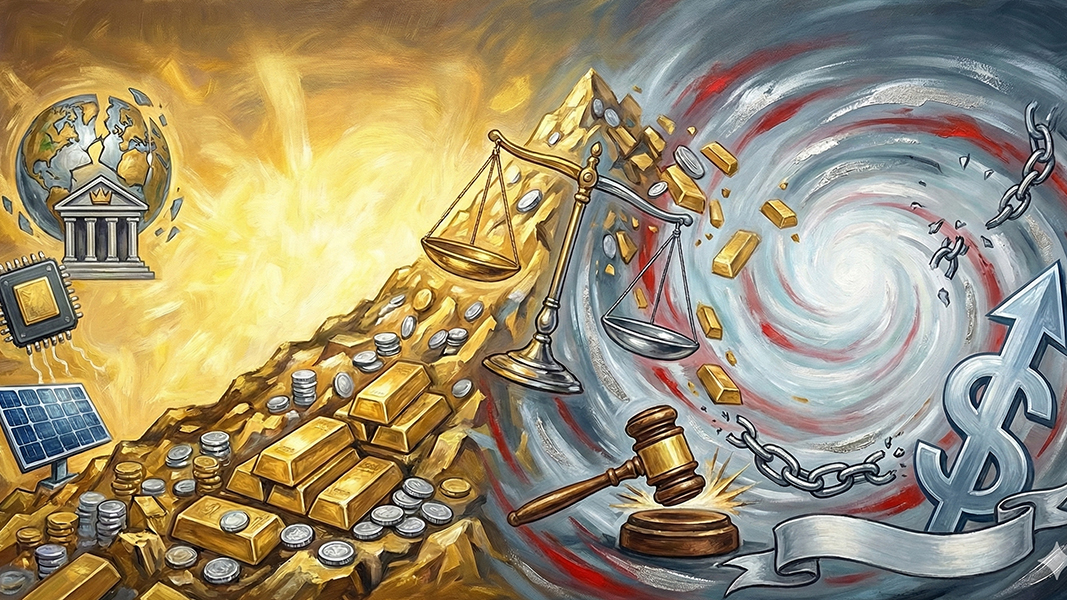
The precious metals market has become a theater of extreme volatility. After a historic “melt-up” that saw gold and silver shatter all-time records in 2025 and the first weeks of January 2026, the market experienced a sudden, violent correction. Understanding this requires looking at the structural forces that built the rally and the specific catalysts that eventually triggered the sell-off.
The meteoric rise of gold (peaking near $5,600/oz) and silver (hitting $121/oz) was not driven by a single factor, but by a rare “perfect storm” of geopolitical and monetary conditions.
Geopolitical Fragmentation: The “Trump 2.0” administration’s aggressive tariff announcements and unpredictable foreign policy (including tensions surrounding Greenland and Iran) created a climate of deep uncertainty. Investors fled to gold as a “re-pricing of trust” in the traditional post-Cold War order.
Central Bank “De-Dollarisation”: Emerging market central banks, led by Poland, India, and China, shifted aggressively into gold to diversify away from the U.S. dollar. In 2025, gold’s share of global official reserves hit a historic 20%.
Monetary Policy and Real Yields: Expectations of persistently negative real interest rates and a weakening U.S. dollar (which hit a four-year low in early January 2026) made non-yielding assets like bullion highly attractive.
Silver’s Structural Deficit: Silver outperformed gold due to a 5th consecutive year of supply deficits. Surging demand from AI data centers, solar infrastructure, and Electric Vehicles met a stagnant mining supply, driving silver’s price parabolic.
The “Warsh Shock”
The turning point arrived with the nomination of Kevin Warsh to succeed Jerome Powell as Chair of the Federal Reserve. Known as an “inflation hawk” and a critic of balance sheet expansion, Warsh’s nomination immediately shifted market expectations.
The violence of the correction was historic, wiping out an estimated $7 trillion in market value in a matter of hours. Gold, which had peaked near a staggering $5,600 per ounce just days earlier, plummeted by over 9% in a single session to break below the $5,000 level. This marked its steepest one-day percentage drop since the early 1980s. The devastation in the silver market was even more profound. After hitting an all-time high of $121 per ounce, silver crashed by over 36% in a single day, its worst performance in history, earning it the title of a “widowmaker” trade. This unprecedented volatility shattered the calm of a market that had been in an almost uninterrupted upward trajectory for over a year.
It was primarily the prospect of a “hawkish” Fed (one that might tighten liquidity and defend the dollar more aggressively) which caused the U.S. Dollar Index to rebound sharply.
The sell-off was also exacerbated by a few of the market’s own internal mechanics:
- Margin Squeezes: The CME Group implemented five margin hikes in just nine days. On the day of the crash, requirements for gold rose to 8% and silver to 15%, forcing over-leveraged “long” positions to liquidate instantly.
- Index Rebalancing: Following the massive 2025 gains, gold and silver had exceeded their allowed weightings in major commodity indices. This triggered automated, systematic selling by index funds to bring allocations back to target levels.
- Technical Exhaustion: Both metals were “overbought” by historical standards. Gold’s Relative Strength Index (RSI) had hit 90, and silver’s touched 93—levels suggesting a correction was not just likely, but inevitable.
Correction or Reversal?
While the $7 trillion market cap loss was staggering, many analysts view this as a “reality check” rather than the end of the bull market. The structural drivers—sovereign debt concerns, geopolitical instability, and industrial silver shortages—remain largely unchanged. For many institutional investors, the drop to $5,000 gold and $90 silver is being viewed as a long-awaited entry point into a market that had simply become too frothy to sustain.